
Most traders do not fail prop firm challenges because they are lazy, unlucky, or completely clueless.
They fail because the challenge rules are built around pressure.
A trader can have a good strategy, a solid win rate, and even a positive expectancy, yet still fail the account because their risk is too large for the drawdown limit. That is the part many traders miss. A prop firm challenge is not just asking, "Can you trade profitably?" It is asking, "Can you reach the profit target before the rules knock you out?"
That difference matters.
In many prop firm accounts, the path of your wins and losses can matter just as much as the final result. One early loss, one oversized trade, one trailing drawdown mistake, or one payout rule violation can turn an otherwise decent strategy into a failed attempt.
That is why tools like the Prop Firm Wizard pass rate calculator are so useful. Instead of guessing whether your strategy can pass, the calculator uses Monte Carlo simulations to estimate your pass probability, expected number of attempts, expected cost until pass, chance of getting a payout, overall expected value, and other helpful metrics. You can also test how different risk levels affect your results across specific firms and account types.
And before choosing any challenge, it is worth checking the actual rules in the Prop Firm Wizard prop firm comparison database, where you can compare account structures and review full firm rules.
Let's break down why most traders fail prop firm challenges, especially when drawdown, risk, and consistency rules start working against them.
Prop Firm Challenges Are Rule Games, Not Just Trading Tests
A normal trading account gives your strategy room to breathe. A prop firm challenge usually does not.
Most evaluations combine several restrictions at once, including:
- A fixed profit target
- A maximum drawdown limit
- Daily loss limits
- Trailing drawdown rules
- Minimum trading day requirements
- Consistency rules
- Payout restrictions
- Scaling or account-specific risk limits
That creates a very different problem from ordinary trading.
You might look at a backtest and see a profitable strategy. But the real question is whether that strategy can survive the exact rule set of the account.
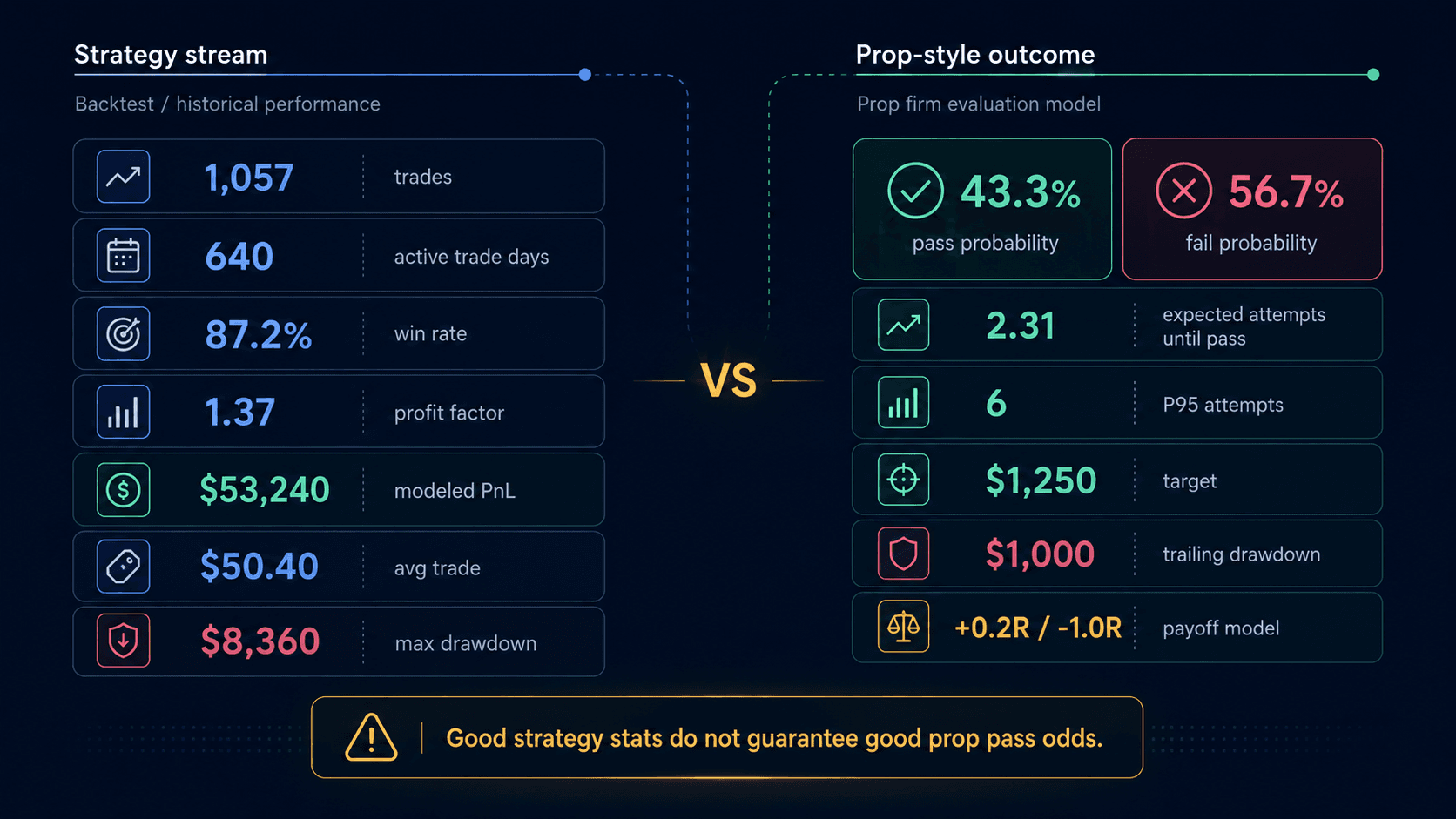
For example, in one strategy research sample, the trading stream had an 87.2% win rate and a 1.37 profit factor. On paper, that looks strong. But under an aggressive prop-style simulation, the same setup had only a 43.3% pass probability and a 56.7% fail probability.
That is the kind of mismatch that surprises traders.
The strategy was not obviously terrible. The issue was the interaction between the account's drawdown rules, the risk per trade, and the sequence of wins and losses.
This is why a prop firm challenge should be treated like a probability problem, not a confidence test.
The Biggest Mistake: Risking Too Much Relative to Drawdown
The most common prop firm mistake is simple: traders risk too much per trade compared with the amount of drawdown they are allowed.
Suppose an account has:
- $1,250 profit target
- $1,000 trailing drawdown
- Wins worth 0.2R
- Losses worth 1.0R
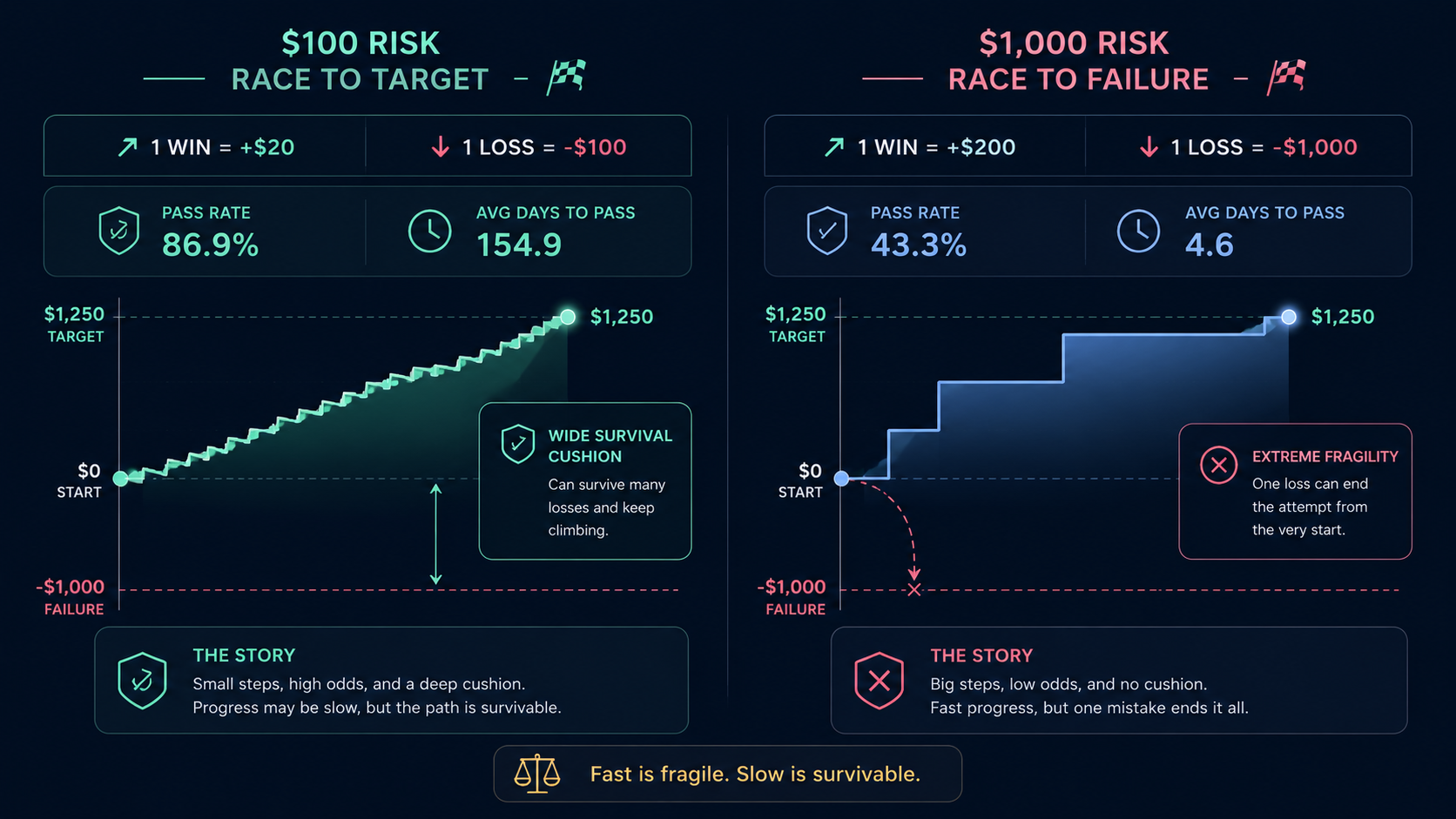
Now imagine risking $1,000 per trade.
One loss can wipe out the entire drawdown allowance from the start. One win only adds $200. So the trader needs to stack several small wins before taking a full-size loss.
That is a fragile setup.
The trader might have a high win rate, but the account does not care about the win rate in isolation. The account cares whether the first few trades happen in the right order.
Now compare that with risking $100 per trade.
A $100 loss is manageable. The account can survive many more losing trades. But each win only adds $20, so reaching a $1,250 target can take a long time.
This is the core trade-off:
Lower risk gives the account more survival room, but it may take longer to pass. Higher risk can pass quickly, but it can also fail quickly.
In one risk sweep from the research sample, the results looked like this:
| Base Risk | Second Trade After Win | Pass Rate | Average Days to Pass |
|---|---|---|---|
| $100 | $120 | 86.9% | 154.9 |
| $200 | $240 | 68.4% | 60.6 |
| $300 | $360 | 50.2% | 29.2 |
| $500 | $600 | 41.8% | 12.4 |
| $1,000 | $1,200 | 43.3% | 4.6 |
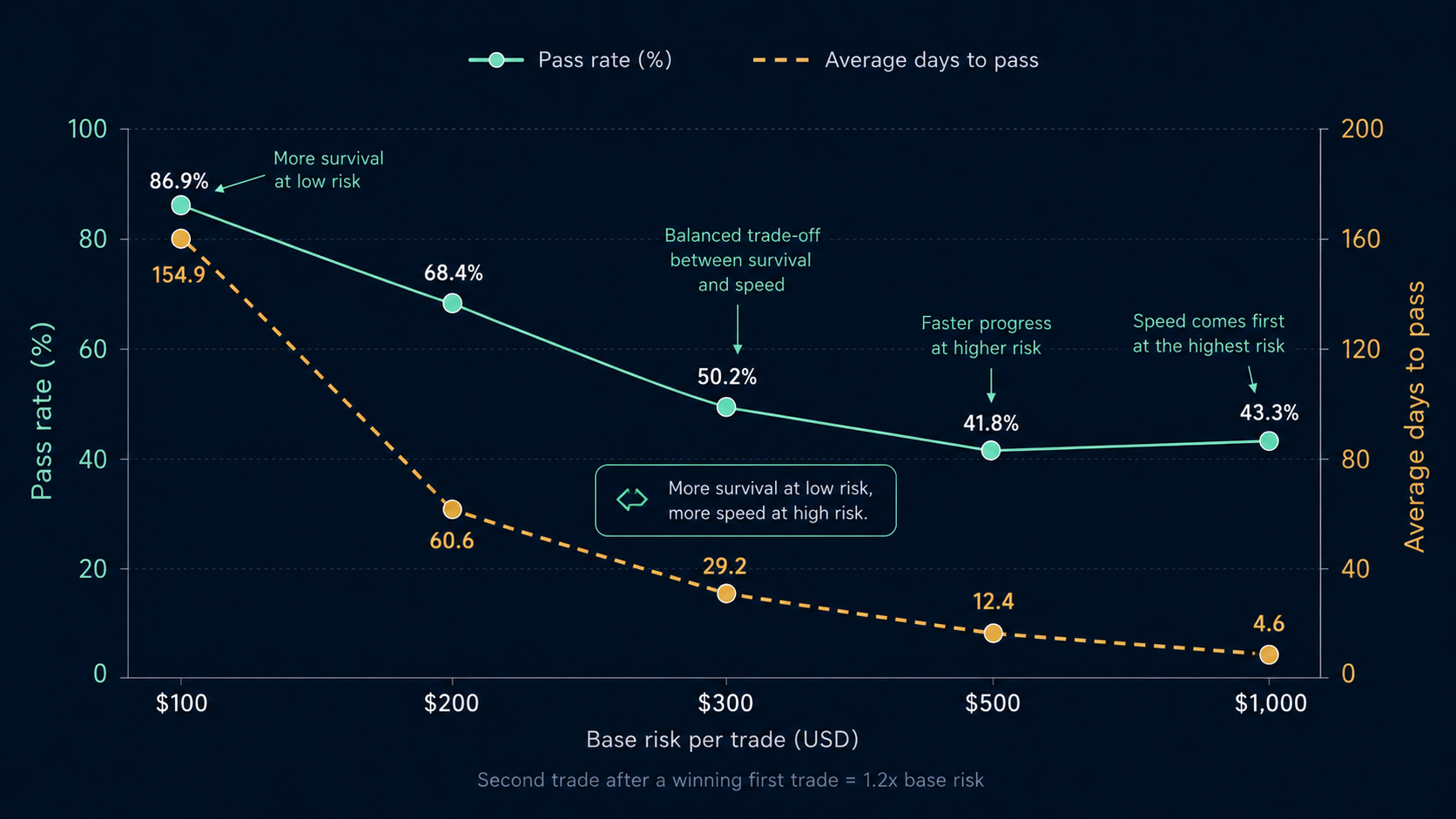
The $100 risk model passed far more often, but it was slow. The $1,000 risk model passed much faster when it worked, but it failed more often.
That is exactly why traders should not choose risk size based only on how fast they want to pass.
Before entering a challenge, use the Prop Firm Wizard pass rate calculator to model different risk levels. The calculator can show how changing risk affects pass probability, expected attempts, expected cost until pass, payout chance, and overall expected value. That is much better than guessing.
Max Drawdown Turns the Challenge Into a Race
Max drawdown is not just a loss limit. It turns the challenge into a race.
You are racing to hit the profit target before your drawdown limit is breached.
This is why profitable strategies can still fail evaluations. If the strategy's normal equity swings are wider than the account's allowed drawdown, the account may fail before the edge has enough time to show up.
In one tested strategy stream, the all-history modeled max drawdown was $8,360. But the simulated prop-style account used a $1,000 trailing drawdown. That does not mean the strategy always needed $8,360 to pass an evaluation. It does show that the strategy's historical equity path was much wider than the simulated account's drawdown allowance.
That is a big warning sign.
A trader looking only at win rate might think, "This should pass easily." A trader looking at drawdown fit might think, "This account may not give the strategy enough room."
The second trader is asking the better question.
When reviewing a prop firm account, compare the account's drawdown rules with your strategy's expected losing streaks, daily losses, and normal equity dips. A setup that looks fine on a large personal account may be a poor fit for a tight evaluation.
You can compare firm rules, account types, profit targets, and drawdown structures inside the Prop Firm Wizard firm comparison database. That page is helpful because the exact rules can change the math.
Daily Drawdown Can Kill a Good Strategy Fast
Daily drawdown rules are especially dangerous because they can punish short-term volatility, even if the long-term strategy is profitable.
A trader might say, "My strategy wins most days."
That helps, but it is not enough.
The real question is, "What happens on the losing days?"
In one day-level strategy sample using modeled $1,000 first-trade risk and $1,200 second-trade-after-win risk, the active trading days were distributed like this:
| Day Pattern | Count | Modeled Day PnL |
|---|---|---|
| WW | 341 | $440 |
| W | 166 | $200 |
| L | 57 | -$1,000 |
| LW | 25 | -$800 |
| WL | 49 | -$1,000 |
| LL | 2 | -$2,000 |
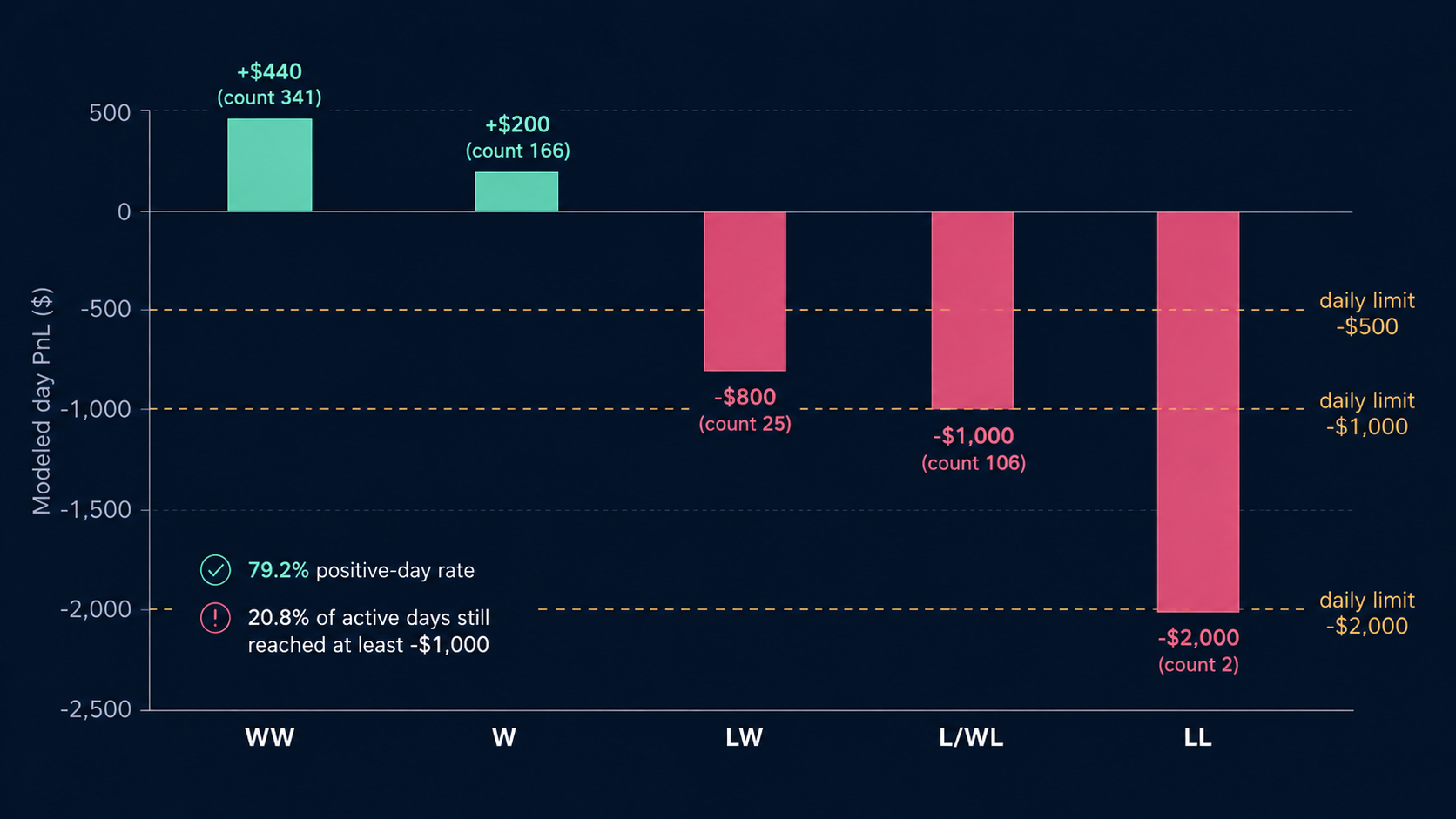
The sample had 640 active trade days. Out of those, 507 were positive and 133 were negative. That is a 79.2% positive-day rate.
Sounds good, right?
But here is the catch: 133 out of 640 active days reached at least -$1,000 from the day start under that risk model. That is 20.8% of active days.
So even with a strong positive-day rate, a daily loss cap could still become a major problem if the trader is risking too much per trade.
This is one of the biggest reasons traders fail prop firm challenges. They focus on how often they win, but the daily drawdown rule focuses on how much damage can happen before the day is over.
A daily drawdown limit does not wait for your strategy's monthly expectancy to play out. It acts immediately.
Trailing Drawdown Is Often Harsher Than Traders Expect
Trailing drawdown is one of the most misunderstood prop firm rules.
With a static drawdown, the loss floor stays fixed. With a trailing drawdown, the loss floor can move up as your account balance rises. That means early profits can reduce your breathing room in ways that feel counterintuitive.
Here is a simple example.
You start with a $1,000 trailing drawdown allowance. You make $200 on the first day. Depending on the firm's rules, the trailing floor may move up from -$1,000 to -$800.
Now you are up on the account, but a $1,000 loss can still fail the challenge.
That is why being in profit does not always mean you are safe.
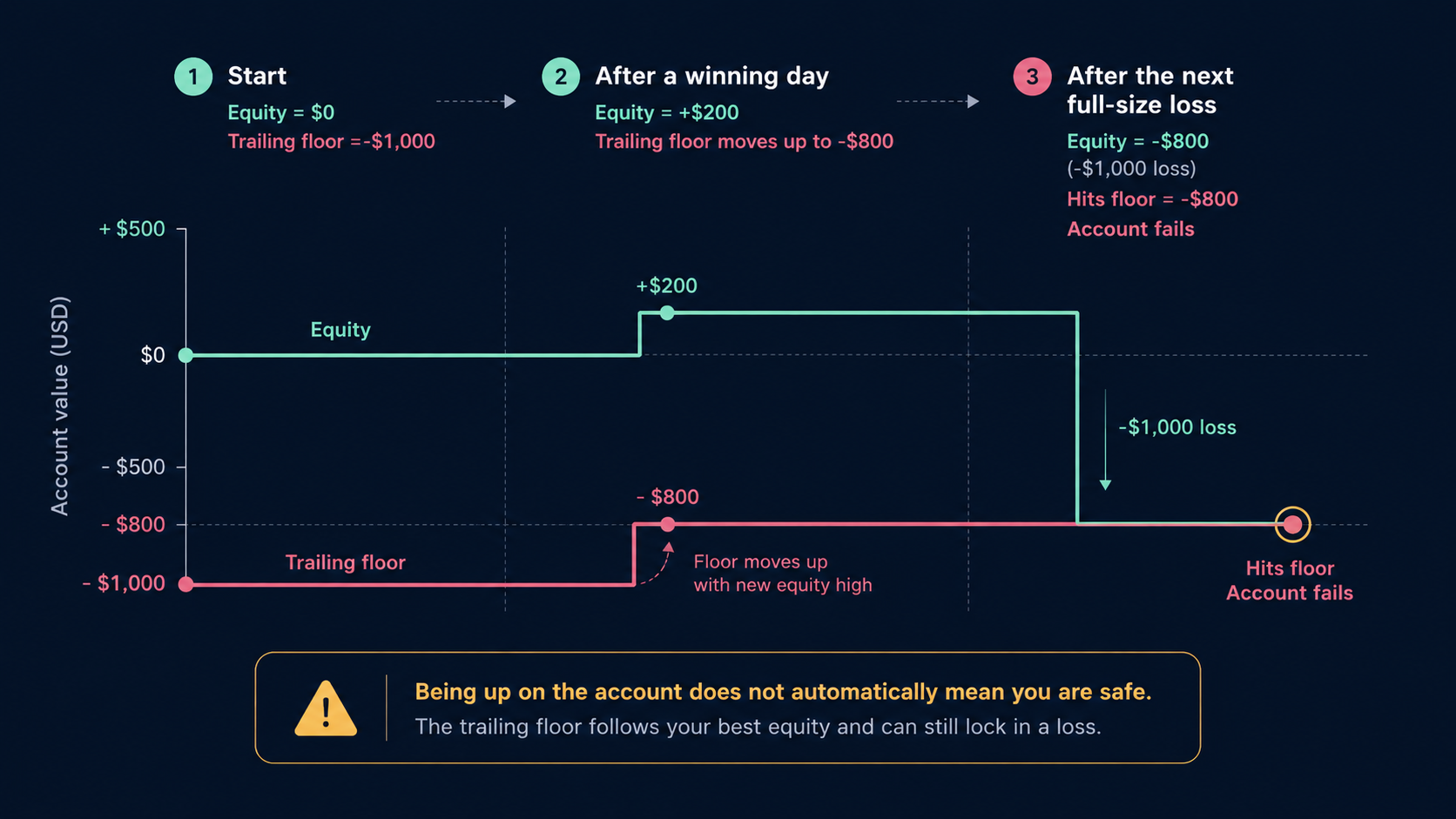
Trailing drawdown punishes the path of returns. A trader can be up early, feel confident, increase size, and then fail from one normal loss because the floor has moved closer.
In one Monte Carlo simulation using a $1,250 target and $1,000 end-of-day trailing drawdown, different risk models created very different outcomes:
| Risk Model | Pass Rate | Fail Rate | Average Pass Days |
|---|---|---|---|
| Flat $100 | 87.5% | 7.2% | 145.0 |
| Flat $300 | 47.6% | 52.4% | 24.4 |
| Flat $500 | 38.1% | 61.9% | 10.3 |
| Flat $1,000 | 35.8% | 64.2% | 4.0 |
| $1,000 first trade, $1,200 after first win | 42.2% | 57.8% | 3.3 |
The aggressive models were fast, but they were fragile. The small-risk model survived better, but it required patience.
This is why traders should model the trailing drawdown rule before taking a challenge. A strategy that looks safe under a static drawdown may be much less safe under a trailing drawdown.
Consistency Rules Can Delay or Block Payouts
Passing the challenge is not always the final obstacle.
Many prop firms also have payout rules. Some require minimum profitable days. Some require a certain number of trading days. Some use consistency rules that prevent one large day from making up too much of the total profit.
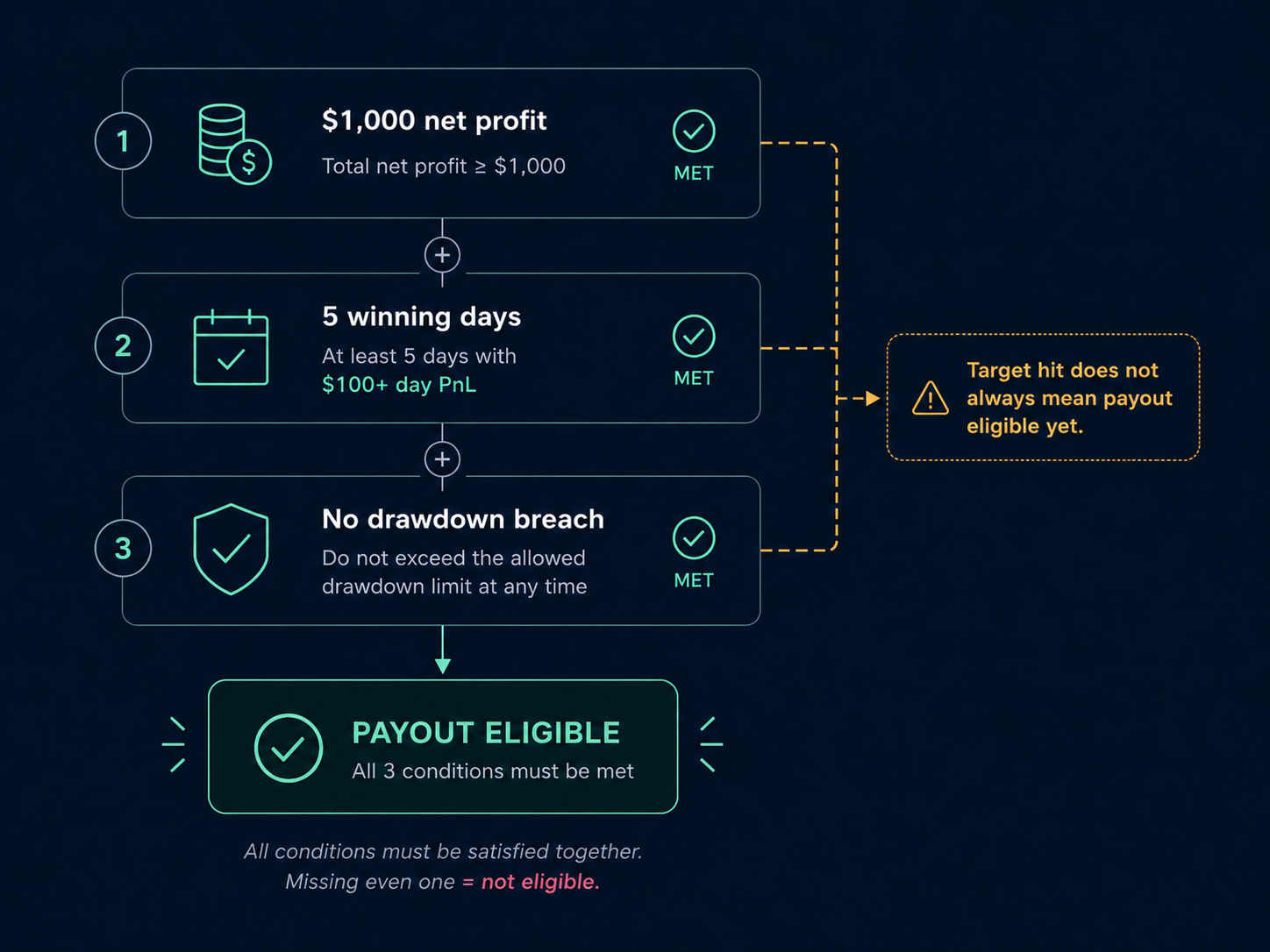
That means a trader can reach the profit target and still not be eligible for payout.
This is where many funded traders get caught.
For example, one funded-account simulation used these payout requirements:
- Reach at least $1,000 net profit
- Record at least 5 winning days with $100 or more in day PnL
- Avoid breaching the $1,000 end-of-day trailing drawdown
- Complete the payout condition within a 60-day simulation window
The payout results changed dramatically by risk level:
| Risk Model | Payout Rate | Fail Rate | Average Payout Days |
|---|---|---|---|
| Flat $100 | 0.0% | 0.5% | 0.0 |
| Flat $200 | 0.0% | 24.2% | 0.0 |
| Flat $300 | 57.2% | 42.5% | 21.5 |
| Flat $500 | 48.6% | 51.4% | 8.9 |
| Flat $1,000 | 31.5% | 68.5% | 5.0 |
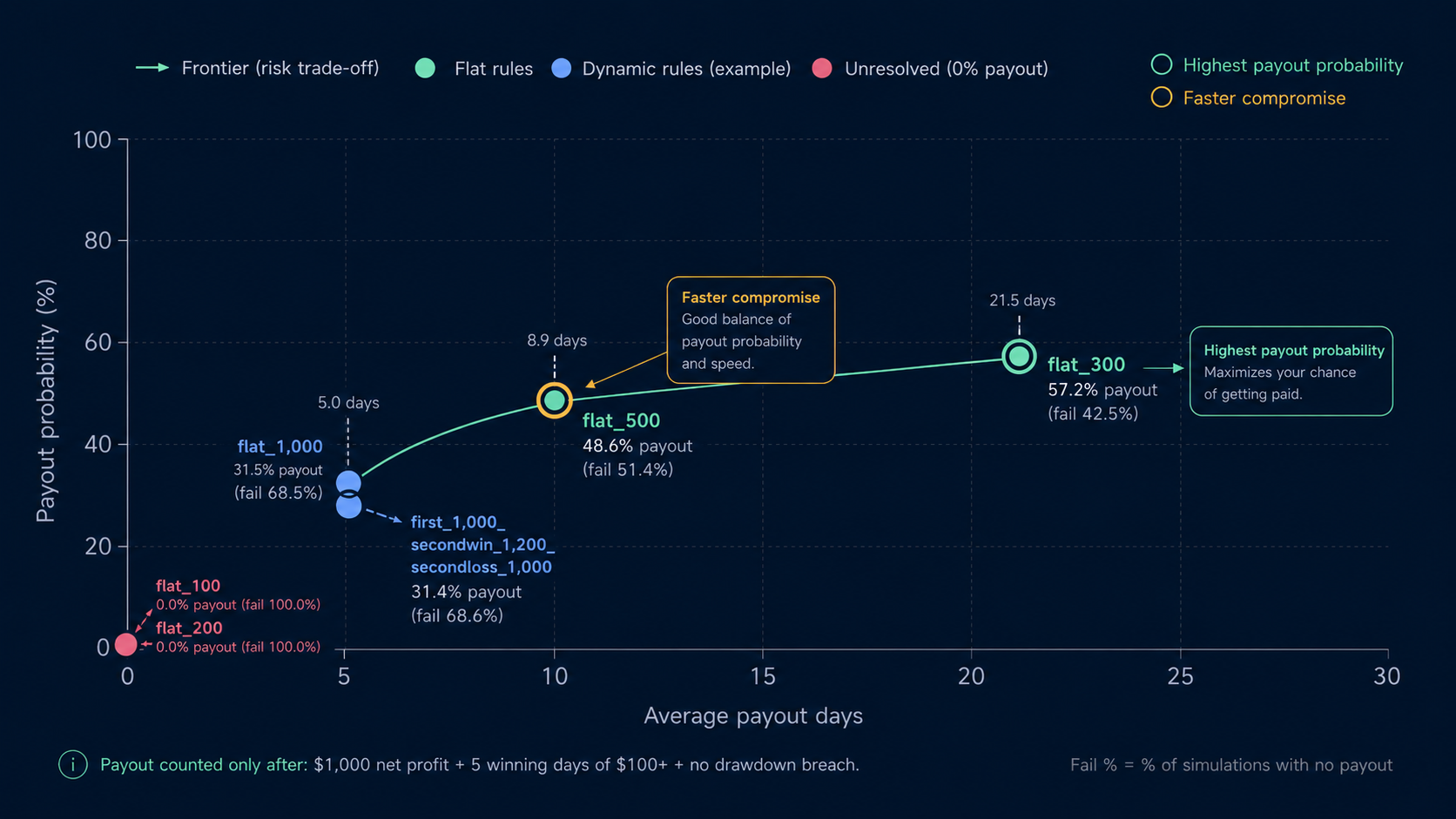
The lowest-risk models survived, but they often could not satisfy the payout rule fast enough. The highest-risk models reached the target quickly when they worked, but they failed much more often.
The middle-risk model had the best payout probability in this simulation.
That is a key lesson.
The best risk level for passing a challenge is not always the best risk level for getting paid. A trader needs to think about the entire path: passing, getting funded, meeting payout requirements, and surviving long enough to withdraw.
The Prop Firm Wizard pass rate calculator is built for this kind of thinking. It does more than estimate pass probability. It also helps model expected attempts, expected cost until pass, chance of payout, and overall expected value so traders can compare strategies more realistically.
Consistency Rules Punish the Shape of Returns
A consistency rule does not only punish reckless trading. It can punish the shape of your profits.
For example, assume a firm has a rule where your largest winning day cannot be more than 30% of your total profit.
If your best day is $440, then you would need at least:
`$440 / 0.30 = $1,466.67 total profit`
That means a trader might hit a $1,250 profit target and still need more profit before the account satisfies the consistency rule.
This is why a large winning day can be both helpful and awkward. It moves the account forward, but it can also raise the amount of total profit needed before the trader becomes payout eligible.
The mistake is thinking of consistency rules as a side note. They can change the optimal way to trade the account. If one oversized day creates a payout problem, the trader may need more days, more controlled profit distribution, or a lower-risk approach that creates a smoother equity path.
How to Improve Your Prop Firm Challenge Odds
You cannot remove uncertainty from a prop firm challenge, but you can stop treating the rules as an afterthought.
A better process looks like this:
- Estimate your strategy's win rate, average win, average loss, and drawdown behavior.
- Compare those numbers with the account's profit target, max drawdown, daily loss limit, and trailing drawdown model.
- Test multiple risk levels instead of choosing the one that feels fastest.
- Check whether payout rules change the best risk level after the challenge is passed.
- Avoid buying accounts where the rules force your strategy into an unrealistic risk profile.
The goal is not to find a magic firm or a guaranteed pass setup. The goal is to find an account where the rules give your strategy enough room to express its edge.
That is a very different mindset from simply buying a challenge and hoping the first week goes perfectly.
Final Takeaway
Most traders fail prop firm challenges because they underestimate the rules.
A profitable strategy is only one part of the problem. You also need the right risk size, enough drawdown room, protection against daily loss limits, a realistic trailing drawdown plan, and a payout path that does not get blocked by consistency rules.
If you want to improve your odds, stop asking only whether your strategy is good.
Ask whether the strategy fits the account.
Then run the numbers before you pay for the challenge. Use the Prop Firm Wizard prop firm comparison database to compare rules, and use the Prop Firm Wizard pass rate calculator to model the account against your own trading assumptions.
Better rule fit will not guarantee a pass. But it can help you avoid the most common ways traders fail before their edge has a real chance to play out.
FAQs
Why do most traders fail prop firm challenges?
Most traders fail because their risk, drawdown exposure, and trading path do not fit the account rules. A trader can have a profitable strategy and still fail if the account's loss limits are too tight for the strategy's normal volatility.
What is the biggest prop firm challenge mistake?
The biggest mistake is usually risking too much per trade relative to the drawdown allowance. Large risk can make the account pass quickly when the sequence is favorable, but it can also fail the account before the edge has time to work.
Is a high win rate enough to pass a prop firm challenge?
No. A high win rate helps, but it is not enough by itself. Loss size, losing streaks, daily drawdown, trailing drawdown, profit target distance, and payout rules can all matter as much as win rate.
Why is trailing drawdown so difficult?
Trailing drawdown can move the failure floor higher as the account makes money. That means an account can be in profit and still be close to failing if the trailing floor has moved up behind the equity curve.
Can consistency rules stop a payout?
Yes. A trader may reach the profit target but still fail to meet payout eligibility if minimum day, winning day, or consistency requirements are not satisfied.
How can I estimate my real pass odds?
Use a prop firm calculator that models your strategy assumptions against the account rules. Monte Carlo testing is useful because it shows how different trade sequences, risk levels, and drawdown rules may affect the probability of passing.